
More about the world’s core: how it shapes everything, and a few words on the order of creation.
Introduction
In the previous article I wrote about the Creator as the core of my world. In this piece we’ll dive deeper into its nature to better understand how its characteristics will influence the world’s development. We’ll also recap the world’s origin story — a foundation for a three-part action plan.
We’ll learn how the Creator made the world so that we can later reproduce its methods and build the world step by step.
Beginnings and the Three Phases of Creation
After reaching the Great Darkness, the Creator realized at some point that it could control the matter of that place. It began forming various celestial bodies.
The Creator’s mind is not so different from a human mind — it possesses a natural curiosity. That curiosity drove it to create a world, but it did not happen instantly. Creation was a process.
I wondered how that process might have looked. Once the Creator discovered the power to shape matter, it began experimenting. I still needed a way to get from that raw power to a finished world. I figured that if humans were to be the last things created, first there must be conditions in which humans could survive. From a narrative standpoint, the Creator started with the easier tasks and gradually moved on to the harder ones. For that reason it began with inanimate matter and only later fashioned living beings and finally humans. Its perspective was cosmic and broad.
I intend to build my world in a similar order. For now, though, I won’t construct an entire cosmos — countless planets and stars. I’ll focus on the environment immediately surrounding the main world, because that world is what matters most. Everything must fit it. So what will the exact sequence be?
I summarized my ideas and concluded that the Creator’s history of shaping the world can be divided into three phases:
- Phase I — Inorganic matter
- Phase II — Organic matter
- Phase III — The human (or sentient) world
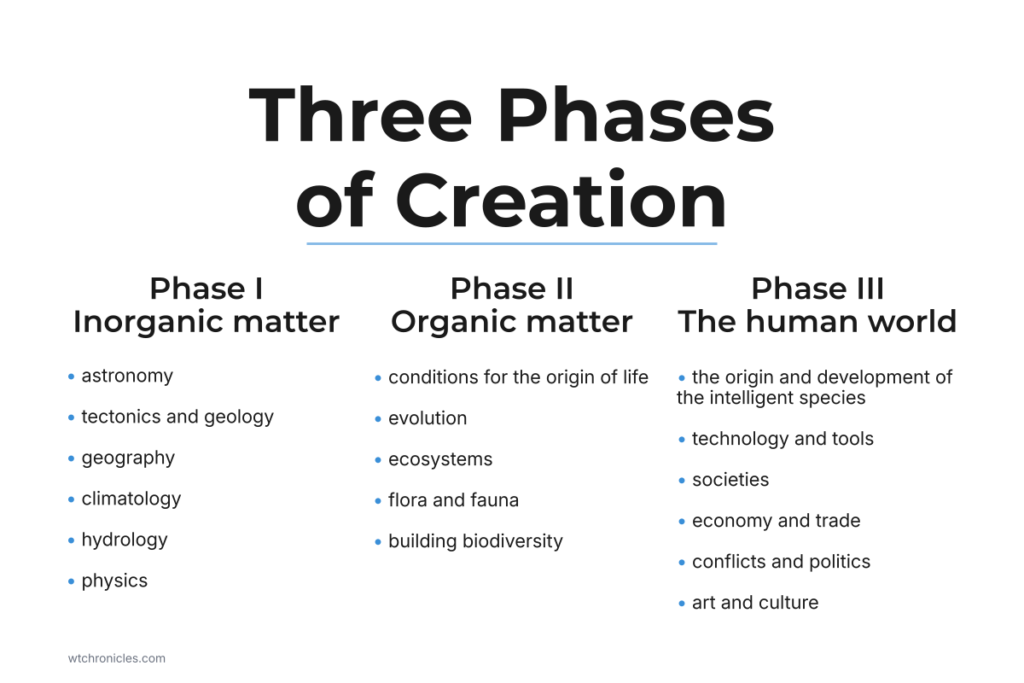
Phase I: Inorganic Matter/The World of Nonliving Matter
These were the beginnings of the Creator’s experiments with matter — the stage where it learned the basic rules of reality.
I decided to start by shaping the world itself, but without any life yet.
I’m building the world to serve stories — to host characters who will live and have adventures. If I dropped those characters into the world at the very start of this phase, they’d find themselves stranded in empty space and would not survive long. There isn’t yet a livable world; I must create it first.
I chose this as the first phase because it forms a useful frame for subsequent stages. It’s easier to imagine a human civilization when you already have the land where it can exist.
This phase covers topics such as:
- astronomy
- tectonics and geology
- geography
- climatology
- hydrology
- physics
Everything from a rocky body drifting through space, to seas and oceans, to atmosphere, climate and landscape shaping — up to the moment before the first living organism emerges. This phase provides the place and the space in which later phases take place. The priority here is the planet itself rather than the whole planetary system.
Why not start with the star, then? Surely a sun will be needed. I decided that since I’m designing the world for stories that take place on the planet (not on the sun), the planet itself is the priority. I’ll create the star later so that it fits the planet — not the other way around.
Phase II: Organic Matter/The World of Living Things
At this stage the world is technically ready to host life, but there isn’t a single living organism yet. The Creator begins forming life — from the simplest organisms to plants, microbes, and onward to more complex groups: mammals, birds, amphibians, reptiles — up until the moment just before humans appear.
I asked myself how life would look for characters placed at the start of this phase. I was missing plants and animals to feed them, and organisms that produce oxygen so they could breathe. The planet is already solid underfoot; now I want to make it capable of sustaining life — in short, to build a functioning ecosystem.
I could simply call this phase biology, because this is the field and set of topics we’ll deal with.
This phase includes, among other things:
- conditions for the origin of life
- evolution
- ecosystems
- flora and fauna
- building biodiversity
Everything from the most primitive lifeforms, through their development and habitats, to the moment just before humanity emerges.
Why separate humans from this phase? Although humans are living organisms, I consider the human world a separate and very extensive subject. Once ecosystems are in place, it will be easier to place people within them and see how different civilizations develop depending on their environment.
Phase III: The Human World
The world was ready for life and it was filled with it. Then the Creator wished to make a being like itself. It created humanity — gave it mind, consciousness, everything that makes a human human. Once it did so, it reached the limits of its ability. Humanity was its greatest creation, containing a piece of the Creator itself. From then on, the Creator could only watch its work.
At this stage I am confident the world can host humans or another intelligent species. The conditions are now right for the rise and shaping of various civilizations.
This phase covers, among other things:
- the origin and development of the intelligent species
And everything that builds that species’ world, for example:
- technology and tools
- societies
- economy and trade
- conflicts and politics
- art and culture
All that which is created by human hands. This phase interests me the most. I can’t wait for the first human to set foot in this world!
Additionally, I plan to introduce a magic system during this phase, because I want that system to be closely tied both to the Creator and to humanity.
Once this phase is complete, the world will be essentially finished.
Conclusion
We now know how the Creator built the world. We know the world’s origin story and the order in which its elements arose. Thanks to this, I can plan what to work on and when — what will be added to the world at each stage.
I quickly realized, however, that there are many elements I want to add to the world. So I need to break the work into smaller parts to actually manage it. That’s why I divided the process into three phases — topics grouped within a single phase have more in common with each other than with topics in other phases. Even these topics are still large, so I plan to split them further into smaller, achievable tasks.
I intend to “follow the Creator’s steps”: step by step I’ll build an action plan and attempt to create this world in the same order the Creator used. We’ll see whether it works.
How about you — in what order do you build your world?